Carrion crows can judge the direction of moving visual patterns and commit to an accurate choice in an average of 235 milliseconds, roughly twice as fast as humans and monkeys performing comparable tasks. Published in Science by neurobiologists at the University of Tubingen, single-neuron recordings reveal that crow brain cells begin separating competing choices within 70 milliseconds, demonstrating primate-like evidence accumulation inside an avian brain that lacks a layered cerebral cortex.
Testing Split-Second Visual Judgment in Carrion Crows
Studying how brains weigh sensory evidence against strict time pressure complements research into strategy switching deficits and dopamine reward pathways. In cognitive neuroscience, one of the classic benchmarks for perceptual decision-making is the random-dot motion task: a participant watches a cloud of moving dots on a screen, where some dots drift coherently left or right while others move randomly, and must decide the dominant direction.
In a study published in Science (DOI: 10.1126/science.aed6459) and reported in a University of Tubingen release on ScienceDaily, researchers Philipp Schmidbauer and Professor Andreas Nieder trained two carrion crows (Corvus corone) to perform this motion-discrimination test on a laboratory touchscreen. Each bird had up to three seconds to indicate whether the dots drifted left or right by pecking a corresponding target.
Rather than taking seconds, the crows responded in an average of just 235 milliseconds, less than a quarter of a second. Crucially, that speed did not come from reckless guessing. On clear motion trials, the crows reached nearly 100 percent accuracy, and even when most dots moved randomly, their choices stayed well above chance while taking slightly longer on harder trials.
Inside the Nidopallium Caudolaterale at 70 Milliseconds
Tracing how biological networks compute fast decisions also informs engineered architectures such as world particle models and integrated photonic neurons. To see what happened inside the birds' brains during those fractions of a second, Schmidbauer and Nieder recorded individual neurons in the nidopallium caudolaterale (NCL), a high-level associative brain region that serves a similar executive role to the mammalian prefrontal cortex.
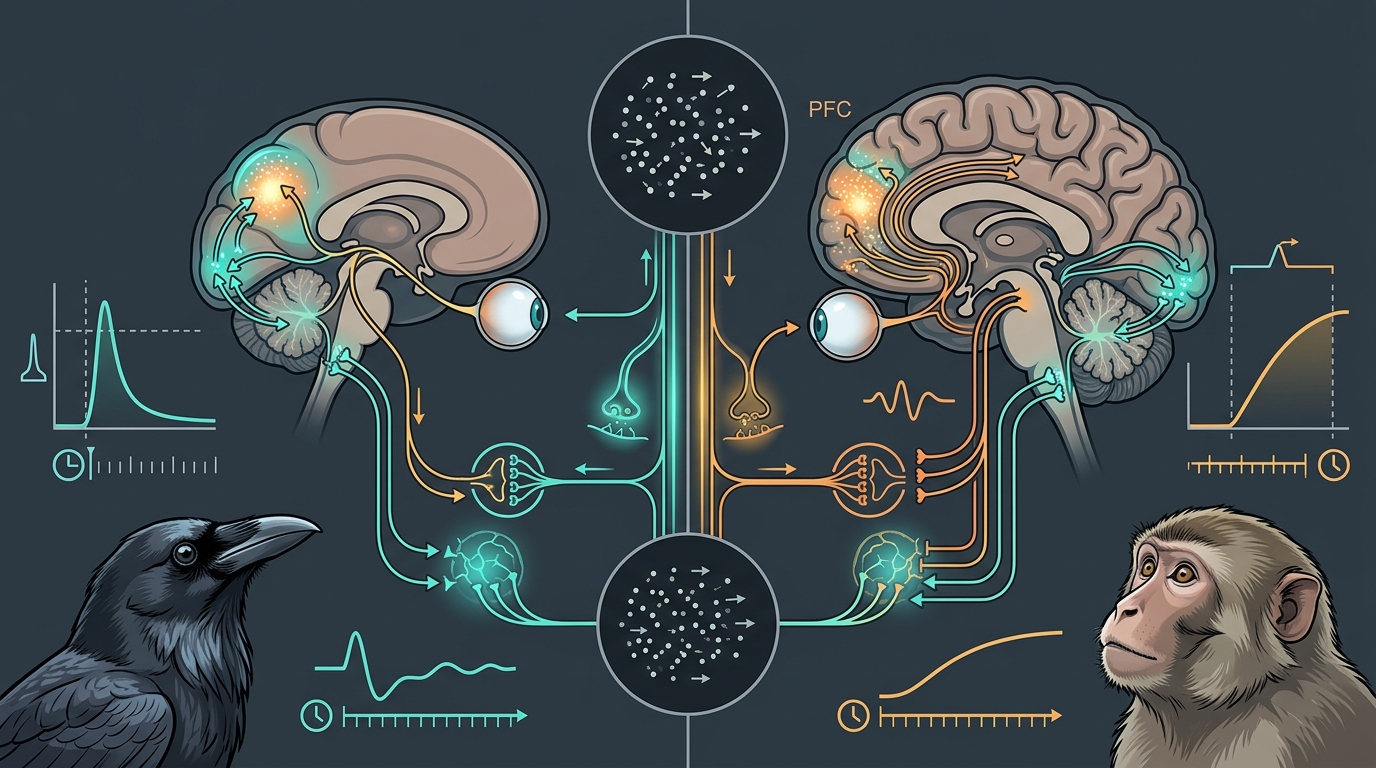
The recordings showed that NCL neurons began distinguishing between leftward and rightward motion just 70 milliseconds after the moving dots flashed onto the screen. As the crows evaluated the visual stream, neural firing rates ramped steadily upward toward a decision threshold well before the birds moved their beaks toward the touchscreen.
That ramping pattern closely mirrors the drift-diffusion and evidence-accumulation dynamics documented in monkeys and humans. Both the strength of the visual signal and the bird's eventual choice were encoded directly in the rising firing rate of NCL neurons.
Convergent Intelligence Without a Layered Cerebral Cortex
Comparing biological efficiency across radically different hardware parallels computational studies of fractal training basins, laser neural surrogates, and mechanical quantum memory. Mammals and birds last shared a common ancestor more than 300 million years ago, and their forebrains evolved along starkly different anatomical blueprints.
Whereas human and monkey decision-making relies on a six-layered neocortex, birds have no layered cerebral cortex at all; instead, their pallium is organized into densely packed nuclear clusters of neurons. Yet Nieder noted that neuronal dynamics in the avian brain follow the same mathematical principles of evidence accumulation established in primates, completing the visual decision loop roughly twice as fast. The table below compares avian and primate visual decision-making architectures.
| Neurobiological Metric | Primates (Humans & Monkeys) | Carrion Crows (2026 Study) |
|---|---|---|
| Executive Brain Region | Prefrontal and parietal cortex (six-layered neocortex) | Nidopallium caudolaterale (nuclear pallial cluster) |
| Average Decision Speed | Roughly twice as slow on comparable dot-motion tasks | 235 milliseconds average response time |
| Neural Choice Onset | Slower cortical integration across layered networks | 70 milliseconds after visual stimulus appears |
| Decision Computation | Evidence accumulation toward firing threshold | Evidence accumulation toward firing threshold |
| Accuracy on Clear Signals | Near 100% with deliberate speed-accuracy tradeoff | Nearly 100% accuracy; slower on ambiguous trials |
Why Flight and Foraging May Have Driven Ultrafast Avian Processing
Why can a bird brain smaller than a walnut outpace a primate cortex on visual motion judgment? Nieder points to the intense evolutionary pressures of powered flight and precision foraging. Navigating through dense branches at high speed or snatching moving prey with a beak leaves no margin for sluggish visual processing.
Because avian neurons are packed more densely per cubic millimeter than mammalian cortical neurons, shorter physical wiring distances between visual centers and the nidopallium caudolaterale may also trim transmission delays. While Schmidbauer and Nieder note that the exact cellular mechanisms behind the twofold speed advantage remain to be isolated, the findings confirm that compact, non-layered brains can execute deliberate cognitive decisions faster than our own.
Frequently Asked Questions
How fast do carrion crows make visual motion decisions?
In University of Tubingen touchscreen experiments, carrion crows needed an average of just 235 milliseconds to determine the dominant direction of moving dots and peck the correct target, roughly twice as fast as humans and monkeys.
Did the crows sacrifice accuracy for speed during the tests?
No. The crows achieved nearly 100 percent accuracy when motion signals were clear, performed above chance on difficult trials, and took slightly longer on harder decisions, showing genuine evidence evaluation rather than guessing.
Which part of the crow brain controls this rapid decision-making?
Single-neuron recordings revealed decision signals in the nidopallium caudolaterale (NCL), an associative avian brain region functionally analogous to the mammalian prefrontal cortex, with choice-specific activity emerging at 70 milliseconds.
Do birds have a layered cerebral cortex like humans?
No. Birds lack a six-layered cerebral cortex and instead organize their forebrain into dense nuclear clusters, yet their NCL neurons still follow the same evidence-accumulation dynamics seen in primate brains.
Why did crows evolve such fast visual decision speeds?
Researchers suggest that powered flight and rapid beak-guided foraging require birds to interpret moving scenery and commit to split-second maneuvers far faster than slower-moving terrestrial primates.