As quantum simulators scale past 50 qubits, supercomputers can no longer check their answers by brute force, leaving scientists with a trust gap. Published in Physical Review X, physicists at the Technical University of Munich and the University of Innsbruck have demonstrated bounded-error quantum simulation (BEQS) on a 51-qubit trapped-ion device, learning the hardware's true interactions and noise directly from experimental data to attach rigorous error bars to its predictions.
The Quantum Verification Dilemma Beyond 50 Qubits
Making large quantum processors trustworthy builds alongside breakthroughs in mechanical quantum memory and oscillating supercurrent readouts. Analog quantum simulators excel at modeling complex many-body physics, such as magnetic phase transitions or exotic quantum materials, because their qubits naturally mimic target interactions.
Yet noisy intermediate-scale quantum (NISQ) hardware is never flawless. Laser intensities drift, stray electromagnetic fields nudge qubits off frequency, and environmental decoherence leaks quantum information. When a simulator holds 10 or 20 qubits, physicists can check its output by running the exact same equations on a classical workstation. Once a simulator reaches 50 or more interacting qubits, however, classical verification hits an exponential wall.
In a study published in Physical Review X (DOI: 10.1103/s96t-n8tx) and detailed by the Munich Quantum Center and ScienceDaily, Tristan Kraft, Barbara Kraus, Manoj K. Joshi, Christian F. Roos, and Peter Zoller introduced a protocol that lets a quantum simulator certify its own uncertainty margins.
How Hamiltonian and Lindbladian Learning Certifies Hardware
Diagnosing real-world hardware behavior complements precision control advances in Majorana parity readouts and optical cavity arrays. Instead of assuming a quantum simulator implements its textbook target equations, the BEQS framework treats the device as a black box and asks what physics is actually occurring inside the vacuum chamber.
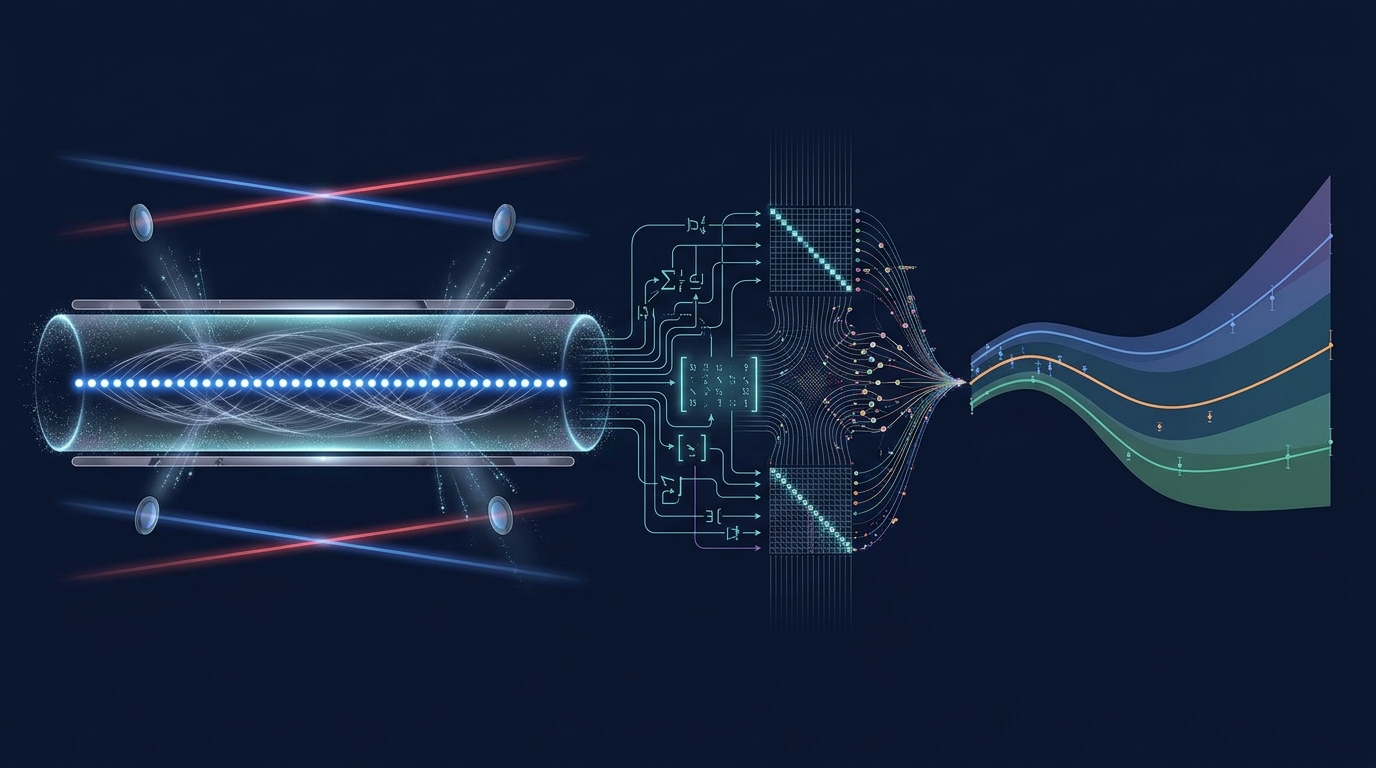
The protocol unfolds in two steps using standard capabilities already available on programmable simulators: preparing simple product states and performing randomized measurements. First, researchers evolve the system for short time intervals and use Hamiltonian and Lindbladian learning to reconstruct both the coherent qubit-to-qubit interactions (the Hamiltonian) and the dissipative noise and fluctuations from the environment (the Lindbladian).
Second, the team mathematically propagates the statistical uncertainties in those learned hardware parameters forward into rigorous upper and lower error bounds on later observable measurements. Crucially, for short-time predictions, those error bounds can be computed purely from experimental data without relying on any classical many-body simulation.
Testing Bounded-Error Simulation on 10 and 51 Trapped Ions
Combining statistical learning with experimental physics parallels computational speedups in programmable photonic chips, subcycle electron jumps, and laser neural surrogates. To prove that BEQS works in practice rather than only on paper, the Munich and Innsbruck teams tested it on trapped-ion quantum simulators implementing long-range Ising spin interactions.
They began with a 10-ion chain, where classical supercomputers can still solve the full quantum dynamics independently. The learned open-system model and its predicted error bars matched both independent measurements and exact classical benchmarks. Next, Manoj Joshi and Christian Roos scaled the experiment up to a 51-ion chain, demonstrating that the learned model reproduced experimental evolution within the predicted bounds even at large system sizes. The table below compares traditional classical benchmarking against the new BEQS framework.
| Verification Dimension | Classical Brute-Force Simulation | Bounded-Error Quantum Simulation (2026) |
|---|---|---|
| Core Approach | Solve ideal quantum equations on classical supercomputers | Learn real Hamiltonian and Lindbladian from device data |
| Qubit Scaling Limit | Exponentially intractable beyond ~50 interacting qubits | Demonstrated on 51 trapped ions; scalable to larger arrays |
| Noise & Drift Handling | Requires idealized or simplified noise assumptions | Captures actual experimental dissipation and fluctuations |
| Output Guarantee | Single point estimate from approximate classical solver | Observable prediction with rigorous, computable error bars |
| Next Hardware Target | Limited to 1D or weakly entangled 2D geometries | Being adapted for large 2D quantum simulators |
Redefining Quantum Advantage Through Verifiable Error Margins
Beyond checking today's one-dimensional ion chains, the researchers are now adapting BEQS for next-generation two-dimensional quantum simulators, where classical approximation methods struggle even sooner as particle counts climb.
As Peter Zoller emphasizes, the breakthrough could reshape how scientists define quantum advantage itself. Instead of judging a quantum device solely by how many qubits it packs or how fast it runs, future benchmarks can compare classical solvers and quantum simulators on a level playing field: which machine solves a complex many-body problem with a smaller, experimentally certified margin of error.
Frequently Asked Questions
Why is it hard to verify quantum simulators above 50 qubits?
Once a quantum simulator reaches around 50 interacting qubits, the number of possible quantum states grows exponentially beyond what even the largest classical supercomputers can simulate directly for comparison.
How does bounded-error quantum simulation (BEQS) check accuracy?
BEQS uses short-time experimental measurements to learn the simulator's actual Hamiltonian interactions and Lindbladian noise, then propagates statistical uncertainties in those learned parameters into verifiable error bars on observables.
How many qubits did the Innsbruck and Munich team test?
Researchers first validated the protocol on a 10-ion system against classical calculations and then demonstrated it on a 51-qubit trapped-ion quantum simulator in Innsbruck.
Does BEQS require a fault-tolerant quantum computer?
No. The protocol was designed specifically for noisy intermediate-scale quantum (NISQ) devices using standard product-state preparation and local measurements, while remaining compatible with future fault-tolerant systems.
How could BEQS change how scientists measure quantum advantage?
Rather than comparing machines only by qubit count or runtime, BEQS lets researchers evaluate quantum advantage by comparing which system delivers a smaller, experimentally certified margin of error.