A modern forensic re-examination of 46 human skulls excavated a century ago near Egypt's First Dynasty royal tombs at Abydos has uncovered potentially lethal head trauma in 18 individuals, or roughly 39 percent of the sample. Published in Frontiers in Environmental Archaeology, the findings provide physical evidence supporting archaeologist Flinders Petrie's 1920s hypothesis that early Egyptian rulers practiced retainer sacrifice around 3000 BCE.
Revisiting Flinders Petrie's Century-Old Abydos Mystery
Reassessing museum collections with modern bioarchaeological tools is reshaping early human history, much like recent studies of fossil enamel proteins and ancient DNA preservation. Roughly 5,000 years ago, the earliest kings of a unified Egypt built monumental mudbrick tombs and funerary enclosures at Abydos.
Surrounding those royal monuments lay neat rows of hundreds of smaller subsidiary graves containing simple coffins, ceramic vessels, copper tools, projectile points, and small ivory figurines. A few stone grave markers even carried names and titles belonging to lower- or mid-level officials and artisans. When British archaeologist Flinders Petrie excavated the site in the 1920s, he argued that so many royal attendants could not have died naturally at once and proposed that they were sacrificed to serve the king in the afterlife.
Yet Petrie could not point to clear fatal wounds on the skeletons, leaving the theory hotly debated for a century. In a study published in Frontiers in Environmental Archaeology (DOI: 10.3389/fearc.2026.1858940) and detailed via ScienceDaily, Purdue University bioarchaeologist Dr. Roselyn A. Campbell tracked down 46 Abydos skulls that Petrie had shipped to Cambridge University's Duckworth Collection.
What Modern Forensics Found on the 46 Preserved Skulls
Documenting skeletal evidence of organized violence in early states parallels archaeological investigations of Scandinavian house burials and Bronze Age fortifications. While Petrie reburied most of the postcranial skeletons in Egypt, the 46 skulls preserved in Cambridge retained subtle clues invisible to 1920s excavators.
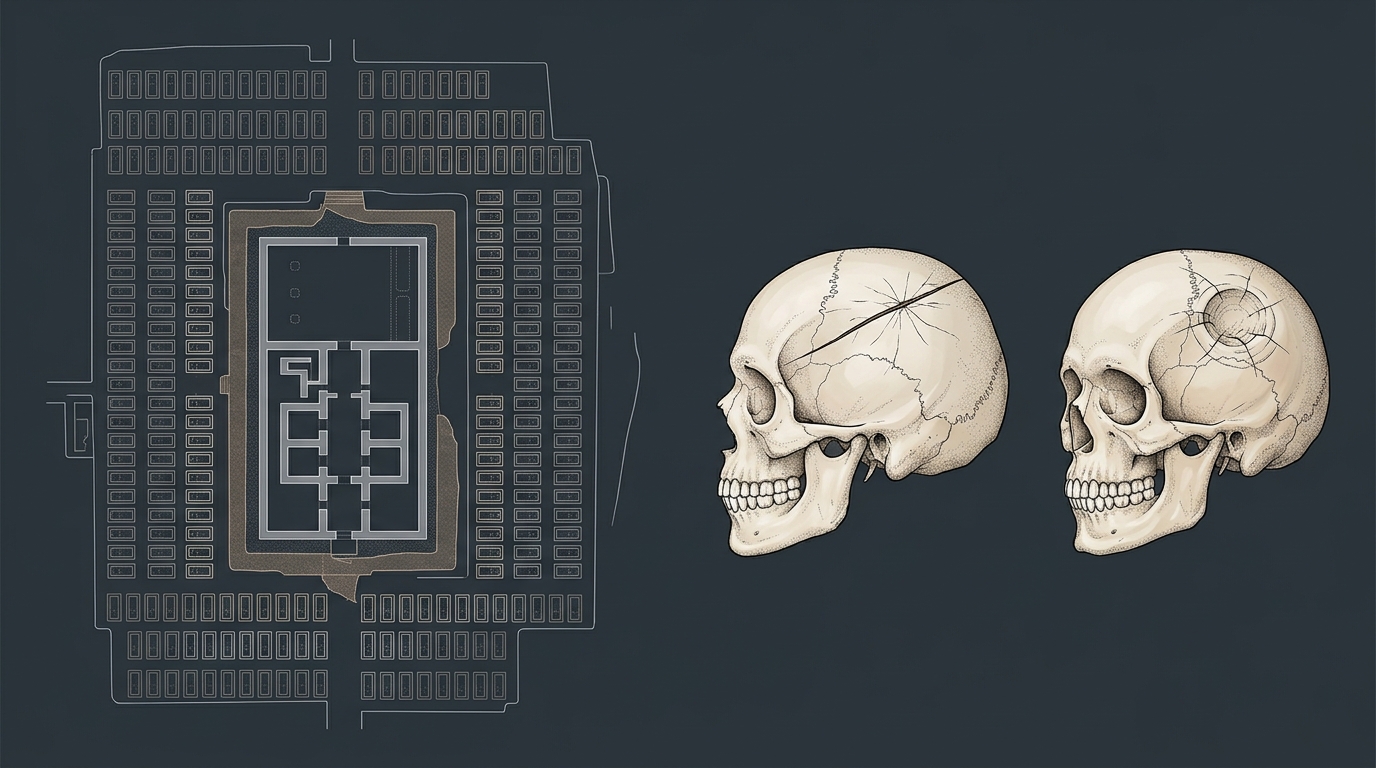
Using modern forensic osteology criteria, Campbell identified substantial cranial trauma on 18 of the 46 skulls, representing at least 39 percent of the examined individuals. Petrie had apparently mistaken these cracks for post-burial soil pressure or natural weathering. Under updated forensic inspection, however, the fracture edges matched perimortem trauma—injuries sustained around the time of death when bone still retains organic elasticity.
Most of the 18 injured crania displayed linear fractures capable of causing rapid unconsciousness, internal bleeding, and death. Several skulls also exhibited sharp-force trauma, including a chopping injury across one individual's eye orbit. Interestingly, the fractures did not match the classic depressed, circular bone indentations expected from an Egyptian royal mace, pointing instead toward broad, flat weapons or blunt impacts.
Why Evidence Gaps Keep Exact Causes of Death Open
Weighing incomplete archaeological records honestly is essential across deep-time research, from ancient urban inequality and Ice Age footprints to ancient eclipse records. Campbell is explicit about what 46 isolated skulls can and cannot prove.
First, the Cambridge sample represents only 5 to 15 percent of each subsidiary burial population, and many graves had been disturbed before Petrie arrived or damaged during shipment. Second, Petrie coated skulls in thick paraffin wax for preservation, which obscures subtle bone color variations that help pinpoint exact timing. Third, because the rest of the skeletons were reburied a century ago, researchers cannot check for defensive fractures on forearms or lethal injuries elsewhere on the body, nor can they rule out non-skeletal methods like asphyxiation in the remaining 61 percent of skulls. The table below summarizes Petrie's 1920s interpretation alongside Campbell's 2026 forensic findings.
| Archaeological Evidence | Flinders Petrie Interpretation (1920s) | Roselyn Campbell Forensic Audit (2026) |
|---|---|---|
| Sample Examined | Hundreds of subsidiary graves around First Dynasty tombs | 46 preserved skulls in Cambridge Duckworth Collection |
| Cranial Cracks | Dismissed as natural post-burial soil damage | 18 skulls (39%) show perimortem cranial trauma |
| Fracture Morphology | No weapon pattern systematically classified | Predominantly linear fractures plus sharp-force eye cut |
| Mace vs. Alternative | Inferred sacrifice from simultaneous burial rows | Rules out typical mace dents; suggests broad flat object |
| Evidentiary Limits | Most postcranial skeletons reburied without full trauma logs | 5%–15% sample; paraffin wax; missing postcranial bones |
Power, Afterlife Belief, and Egypt's Earliest Kings
Even with those caveats, accidental falls are an unlikely explanation for the 18 fractured crania, since falls severe enough to split a skull typically leave broken collarbones, ribs, or limbs that Petrie's meticulous field notes did not record. Together, the linear fractures and sharp-force wounds transform retainer sacrifice at Abydos from a purely circumstantial inference into a forensically grounded reality.
As Campbell notes, retainer sacrifice around 3000 BCE served both religious and political functions: ensuring royal artisans and mid-level officials could continue serving the king in the afterlife while staging an unmistakable display of absolute First Dynasty power. Notably, the practice disappeared rapidly after Egypt's First Dynasty, making the Abydos skulls a rare window into a short-lived, violent chapter at the dawn of pharaonic civilization.
Frequently Asked Questions
How many Abydos skulls showed signs of violent head trauma?
Out of 46 First Dynasty skulls preserved in Cambridge University's Duckworth Collection, 18 skulls—roughly 39 percent—displayed substantial perimortem cranial trauma, primarily linear fractures alongside several sharp-force injuries.
Why did Flinders Petrie miss the fatal skull fractures in the 1920s?
Petrie lacked modern forensic osteology standards and appears to have mistaken the perimortem linear cracks for natural post-burial damage caused by soil pressure or excavation handling.
Were the royal attendants killed with an Egyptian ceremonial mace?
Probably not. Ceremonial maces typically leave depressed circular fractures where bone pushes inward, whereas the Abydos skulls mostly show linear fractures consistent with a broad, flat object.
Does this study prove all people buried around Abydos tombs were sacrificed?
No. The 46 skulls represent only 5 to 15 percent of the burial population, and because most skeletons were reburied, researchers cannot confirm how the remaining 61 percent of individuals died.
What was retainer sacrifice in ancient Egypt?
Retainer sacrifice was a short-lived First Dynasty practice around 3000 BCE in which officials, artisans, and attendants were killed upon a king's death to serve the ruler in the afterlife and demonstrate royal authority.